

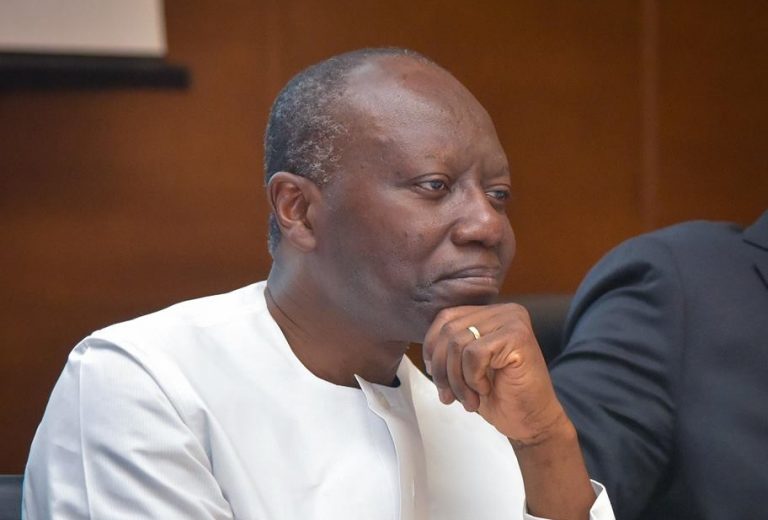

The issues surrounding former Finance Minister Ken Ofori-Atta require a disciplined separation of law, politics and public perception. This is not a case that should be tried in the media, nor should it be diluted by partisan storytelling. It is a matter that calls for facts, institutional memory and restraint.
Ken Ofori-Atta served as Ghana’s Minister for Finance under Former President Nana Addo Dankwa Akufo-Addofrom 2017 to 2024. Over the years, he emerged as one of the most controversial figures of that administration, facing criticism over debt accumulation, fiscal decisions and specific state contracts. Calls for his resignation came not only from the opposition but also from sections of the New Patriotic Party (NPP), including Members of Parliament who argued that his continued stay in office had become politically and economically untenable. Despite this pressure, Akufo-Addo repeatedly expressed confidence in him and retained him until the final year of his government.
Following the change of administration, the Office of the Special Prosecutor (OSP) initiated investigations into Ofori-Atta over alleged corruption and procurement-related matters. When he failed to honour invitations to appear before the OSP, the office declared him a wanted person and activated processes for international cooperation.
It is within this context that developments in the United States entered the conversation. Ken Ofori-Atta’s interaction with U.S. Immigration and Customs Enforcement (ICE) has since been framed by some as proof of guilt. That interpretation is inaccurate. ICE is a general U.S. immigration enforcement agency whose mandate covers visa status, overstays and civil detention pending immigration proceedings. International media, including Reuters and the BBC, have repeatedly noted that ICE actions are administrative in nature and affect thousands of non-citizens every year, often without any criminal conviction. ICE is not a court, and its actions do not amount to a judicial finding under Ghanaian law.
Domestically, the matter has unfolded alongside renewed controversy over the Office of the Special Prosecutor itself. Members of the current parliamentary majority have sponsored proposals questioning the relevance of the OSP and, at different points, called for its repeal — a position some of them previously opposed when they sat in opposition. President John Dramani Mahama did not endorse the scrapping of the OSP; instead, he intervened to halt such moves, describing them as premature and urging institutional strengthening rather than dissolution.
Political reactions to the Ofori-Atta case remain sharply divided. NPP General Secretary Justin Frimpong Kodua has publicly argued that if the state believes it has sufficient evidence, it should rely on formal prosecution rather than public commentary, even suggesting prosecution in absentia where legally permissible. On the other hand, figures within the governing party insist the former minister must return to Ghana to answer the charges directly.
At this point, it is impossible to ignore a wider institutional memory that complicates public trust. In the lead-up to the 2024 general elections, the same Office of the Special Prosecutor cleared then-candidate John Dramani Mahama of wrongdoing in the long-running Airbus matter, citing insufficient evidence to sustain criminal charges. That decision, while lawful and final, divided public opinion. To some, it reinforced the independence of the OSP; to others, it raised questions about consistency, timing and selective accountability. This history matters, because institutions do not operate in a vacuum — they operate in public memory.
This editorial takes no position on the guilt or innocence of Ken Ofori-Atta. That determination lies solely with the courts. What is clear is that immigration enforcement abroad must not be confused with criminal adjudication at home, and political disagreement must not be allowed to weaken accountability institutions through convenience or contradiction.
Ghana’s democracy is tested not when cases are popular, but when they are difficult. Justice is not served by silence, and it is not served by noise. It is served by evidence, consistency and respect for due process — regardless of whose name is involved.