

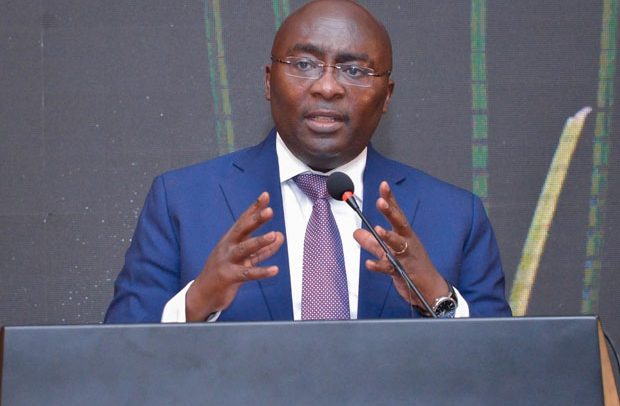

Former Vice President and Economist Dr. Mahamudu Bawumia has urged policymakers to rethink the reliance on tariffs as a remedy for trade deficits, underscoring that these deficits arise from macroeconomic imbalances rather than failed trade policies.
Speaking at the International Democracy Union Forum in Brussels on May 17, Dr. Bawumia pointed out that Africa accounts for a mere 2.5% of global exports and 2.9% of imports, with major trade dominated by Asia, Europe, and the United States. This structural trade pattern, he argued, requires solutions beyond protectionist measures.
“If you look at the share of global trade, Africa contributes just 2.5% of global exports and 2.9% of imports, while Asia, Europe, and the U.S. dominate global trade flows with significant imbalances,” he noted.
Dr. Bawumia explained that trade deficits stem from the gap between a nation’s savings and investment levels. When a country spends more than it saves, it inevitably runs a trade deficit — a challenge deeply rooted in macroeconomics, not in trade policies. He emphasized that tariffs are ineffective in addressing this fundamental issue, highlighting lessons from history, including the 1930s Smoot-Hawley Tariff Act and the recent U.S.-China tariff war, both of which worsened economic conditions globally.
“You cannot fix a trade deficit with tariffs, it simply doesn’t work,” Dr. Bawumia stated.
While Africa is somewhat insulated from U.S. trade disruptions—exporting 6.5% and importing 4.4% of goods to and from the U.S.—some African economies remain vulnerable. For example, Lesotho relies heavily on textile exports to the U.S., which account for about 50% of its total exports under the African Growth and Opportunity Act (AGOA).
Dr. Bawumia suggested that Africa’s best path forward lies in increasing self-reliance and deepening intra-continental trade partnerships to mitigate the impact of external shocks.
“Africa’s response to global trade disruptions will include a renewed push for self-reliance and stronger intra-African trade ties,” he predicted.
The former Vice President’s insights call for a shift away from tariff-centric policies toward broader economic reforms and regional cooperation to build resilient African economies.