
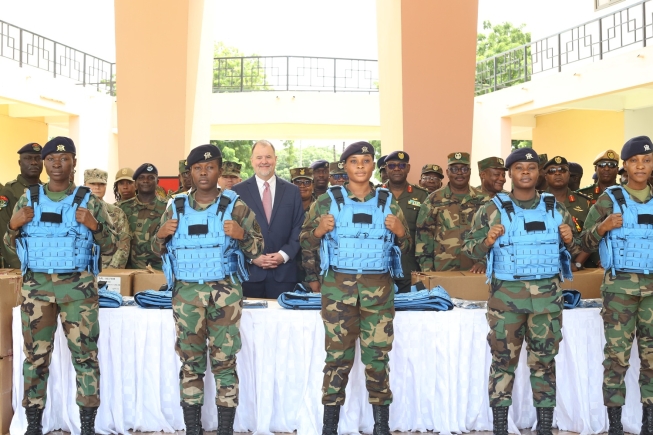

The United States government under President Donald Trump has donated women’s body armor valued at over $1 million to the Ghana Armed Forces (GAF).
The initiative is aimed at strengthening the safety and effectiveness of female soldiers, particularly those deployed on high-risk United Nations peacekeeping missions across the globe.
The donation marks a significant step in addressing a long-standing gap in military logistics, where female personnel have often been forced to adapt to protective gear designed for men. According to officials, the specialized armor is tailored to meet the physiological needs of women, thereby enhancing both comfort and operational efficiency.
Speaking at a ceremony at Burma Camp, the U.S. Chargé d’Affaires, Rolf Olson, emphasized that the support reflects Washington’s commitment to Ghana’s peacekeeping contributions and to advancing gender inclusion in global security. He praised Ghana for consistently ranking among the top 10 troop-contributing countries to UN missions, highlighting the discipline and professionalism of its service personnel.
“This donation is not just about equipment; it is about ensuring that every soldier, regardless of gender, has the protection they deserve while serving humanity. Women bring unique perspectives and skills to peacekeeping, and when they are fully equipped, missions become stronger and more effective,” Olson stated. He noted that the Trump administration’s support builds on the Women’s Body Armor Pilot Project launched in 2023 with Ghana, the Netherlands, and Zambia.
Receiving the donation, the Chief of Army Staff, Major General Lawrence Gbentanu, described the gesture as historic and timely. He explained that it was the first time female-specific armor had been provided to the GAF, and that it would go a long way to boost confidence, mobility, and safety for women in uniform. “For years, our women have had to make do with protective gear not designed for them. Yet they never relented in serving. This support sends a strong signal that their sacrifices are recognized,” he said.
Military analysts say the Trump administration’s move not only strengthens Ghana’s operational capacity but also underscores a broader shift in U.S. foreign policy that links security, gender equity, and international partnerships.
By equipping female personnel for the frontlines of peacekeeping, the United States and Ghana are jointly investing in a future where inclusion enhances both security and stability.